
Air conditioning
What gas does your A/C take? Pop your reg in and find out.
We'll tell you whether your vehicle runs on R134a or R1234yf and roughly how many grams it needs for a full charge — before you book, before you pay, no guesswork.
Your air conditioning doesn't run out. It leaks.
The refrigerant inside is a sealed loop — it goes round and round and isn't consumed the way fuel or oil is. Every system loses a very small amount over the years through hoses and seals, which is why a regas every few years is normal. But if it was cold last summer and it's blowing warm now, something has gone wrong, and simply putting more gas in only treats the symptom.
Running the system low on refrigerant can damage the compressor — by far the most expensive part in it. The refrigerant carries the oil that lubricates the compressor, so low gas means low oil circulation, and a compressor that starves eventually seizes. A simple regas can turn into a four-figure repair. If your system has lost its charge in under a year, it needs testing properly before anything goes back in.
Here's how a proper repair actually works — in four steps:
Step 1
Nitrogen pressure test: does it hold?
No cold air, or it needs gas? The proper first step is a nitrogen pressure test — not a recharge. Putting gas in without checking often just tells you it's leaked back out a few days later, by which point you've paid for refrigerant that's gone.
Once the old refrigerant is safely recovered, we pressurise the system with dry nitrogen, then leave it and monitor it. If the pressure holds steady, the system is sound and we recharge — job done. If it drops, there's a leak, and you've found that out before paying for a refill that won't hold.
Why nitrogen, not just compressed air?
Compressed air carries moisture. Water inside an air-con system reacts with the oil to form acid, which corrodes the system from the inside — and compressed air mixed with oil under pressure is a genuine fire risk. Nitrogen is dry, inert, and does neither.
We account for temperature
Pressure in a sealed system rises and falls with the workshop temperature — a car that comes in cold on a winter morning and warms up will show a pressure change that looks like a leak but isn't. Reading a gauge without allowing for that is how systems get condemned for faults they don't have.
Nitrogen pressure test — £25
Step 2
Pinpoint it: hydrogen leak trace
Knowing there's a leak and knowing exactly where it is are two different jobs. For the small ones, we use forming gas — a mixture that's mostly nitrogen with a small amount of hydrogen in it, completely non-flammable at that concentration and entirely safe to use on a vehicle.
Hydrogen is the smallest molecule there is. It will escape through a leak so small that nothing else would ever reveal it — the kind of pinhole that empties a system slowly over twelve or eighteen months and leaves no visible trace. A specialist electronic detector then sniffs it out and pinpoints exactly where it's escaping.
Why this matters most for evaporator leaks
The evaporator sits buried behind the dashboard — on many vehicles, getting to it means removing the entire dash, a day's labour or more. You don't want to commit to that job on a guess. With forming gas we pressurise the system, let the heater box fill, then test at the condensate drain under the car and at the vents inside it. If the evaporator is leaking, it shows up in minutes, without a single trim panel coming off. If it isn't, you've saved yourself a very expensive stripdown for nothing.
What about UV dye?Dye has its place, but real limitations — it has to circulate before it shows anything, so the system needs enough gas in it to run at all. It won't reveal the very small leaks, and once it's in a system it stays there, so a stain spotted two years later could be an old repair or a new fault. We'd rather find the leak properly the first time.
Hydrogen leak trace — £100
Step 3
Fix what's found
If a test finds a leak, we repair the actual fault — not just mask it. This is the bit a recharge on its own always skips.
Step 4
Deep vacuum, weighed recharge — and it stays cold
Once a leak's repaired, or if there was never one, the system goes under deep vacuum before recharging. This boils off any moisture that got in while the system was open. Skipping this step is one of the most common shortcuts in the trade, and it's why some systems fail again within a year regardless of how good the repair was.
Only then does the correct weight of refrigerant go back in — weighed to the manufacturer's specification, not topped up until it feels about right. Over-charging performs as badly as under-charging and strains the compressor. Because the system's sound, it stays cold — instead of slipping away over the next few days.
R134a (pre-2014 cars, most motorhomes)
£35 + 6p / g
Typical car (500 g) = £65. Motorhome on Fiat Ducato (900 g) = £89.
R1234yf (2017+ cars)
£45 + £0.16 / g
Typical car (500 g) = £125. Transit (650 g) = £149.
Why so different?R1234yf is the newer, lower-GWP gas mandated on cars sold from 2017. It's roughly 5× more expensive per gram for us to buy in, so the customer price reflects that. Nothing's marked up arbitrarily — the breakdown is right there on your quote.
What do you want to book?
Choose your service
How to really check your air conditioning
What you can check yourself
- Run it properly — engine running, air con on, coldest setting, fan on full, set to recirculate. Give it five minutes.
- Feel the vent temperature — a healthy system should be noticeably, uncomfortably cold, not just “cooler than outside”.
- Listen for the compressor — a soft click and a slight change in engine note when it engages. Nothing at all can mean the pressure switch has cut it out to protect a low system.
- Check for a smell — a damp or musty smell usually means the cabin filter and evaporator need cleaning, not a refrigerant fault.
- Look for oily residue — dark staining around pipe joints, the condenser or the compressor is often a leak, since the oil escapes with the gas.
- Check the drain — a small puddle of clear water under the car on a hot day is normal condensation. Water in the footwell is not.
- Run it in winter too — ten minutes a month keeps the seals lubricated and is the cheapest way to avoid a leak in the first place.
What a proper professional check includes
- Recovery and weighing of the existing gas — knowing exactly how much came out shows how much has been lost and how fast.
- A nitrogen pressure test with a proper hold period, not a two-minute glance at a gauge, with temperature accounted for.
- Electronic leak detection with forming gas where a leak is confirmed but not visible, including at the drain and vents for evaporator faults.
- Inspection of the condenser, compressor, pipework and seals for physical damage and corrosion — stone damage behind the grille is extremely common.
- A pressure and temperature performance check on both sides of the system, so a fault that isn't a leak — a failing expansion valve, a blockage, a tired compressor — gets identified, not masked by more gas.
- Deep vacuum before recharge, held long enough to confirm the system is dry and sealed.
- A weighed charge to the manufacturer's specification — not topped up until it feels about right.
- A written result — what was found, what was measured, what was done.
If you've had your air conditioning regassed more than once in three years, you have a leak — and nobody has found it yet.
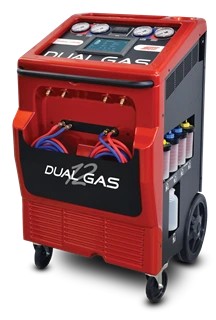
We'll always tell you straight whether you need a proper repair or just a recharge — and do whichever it actually is.